Community Resilience: 10 Real-World Examples
“Community resilience” is a term gaining momentum in the news, in grant applications, and neighborhoods across the nation as we plan for a sustainable future.
A plain-language definition: community resilience is a community’s ability to prepare for, withstand, and bounce back from hard times… a wildfire, a flood, a plant closure, a pandemic, a heat wave… and maybe even come out stronger rather than more divided.
Resilience isn’t one thing. It’s housing people can afford, jobs that stay local, clean air and water, places to gather, and neighbors who know each other. And many of the places where those things are missing sit right next to vacant, underused, or contaminated land.
For this reason, brownfields can be useful bridges to build community resilience. A brownfield is a property where reuse is complicated by real or suspected contamination: an old gas station, a shuttered mill, a former dry cleaner. These sites are often concentrated in the very neighborhoods that need resilience most. Cleaning up brownfields and putting them back to work is one of the most direct ways to increase community resilience.
Below are 10 concrete examples of what community resilience looks like on the ground, and how brownfields redevelopment can help make each one real.
1. Affordable, stable housing
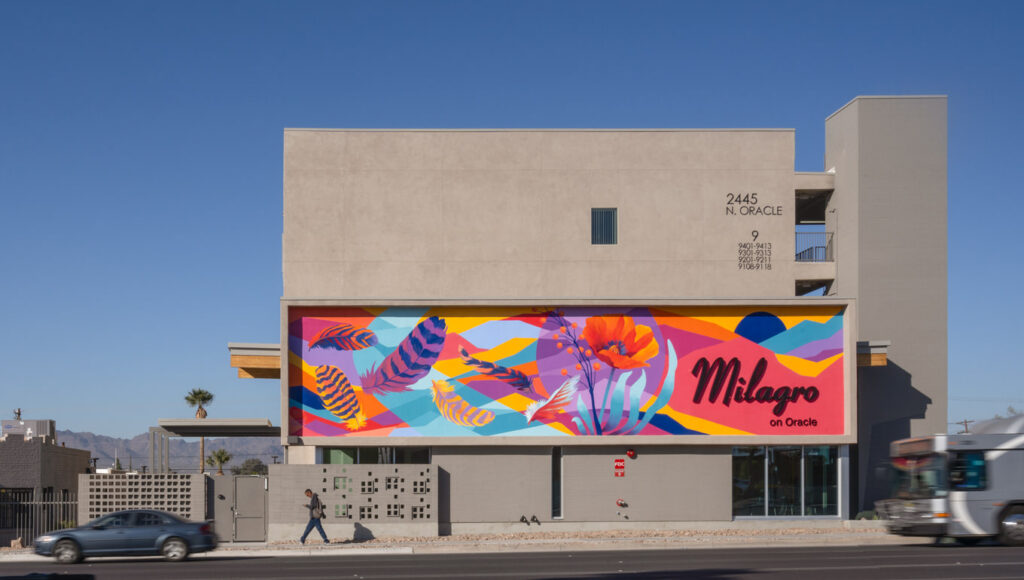
Milagro on Oracle, Tucson AZ
What it looks like: Families can stay in their neighborhood through rent spikes, job loss, or a disaster. Fewer people are displaced, and social ties stay intact.
How brownfields help: Former industrial and commercial sites are often well-located near transit, services and existing jobs. Redeveloping them as affordable or mixed-income housing adds homes without pushing into open space and puts land that’s been idle for decades back into service for residents.
Example: Milgro on Oracle, Tucson, AZ: Oracle Road was once a vibrant transportation corridor lined with mid-century motels, restaurants and lots of neon lights. When I-10 was constructed, the street lost its glow and has been underinvested for the past 60 years. Tucson’s extensive “Thrive in the 05” planning identified affordable housing for a central need of this part of the City. The City purchased two under-utilized motels and an empty lot in between and utilized EPA Community-Wide Assessment funding to ensure the sites were clean and ready for housing. The result is Milagro on Oracle with 62 units of affordable senior housing. This project preserved two mid-century motels and created a new four-story building to deliver much-needed housing for vulnerable senior citizens. Watch the Video
2. Local jobs and a diverse economy

Indian Valley Wood Utilization Campus, Crescent Mills, CA
What it looks like: A community isn’t dependent on a single employer. When one business closes, others are there to absorb workers.
How brownfields help: Cleaned-up sites can become small-business incubators, light manufacturing, commercial kitchens, or maker spaces. Cleanup itself creates jobs too, and local workforce training programs can prepare residents to fill them.
Example: Indian Valley Wood Utilization Campus– Crescent Mills, CA: many towns in the mountain west have experienced widespread job loss from the collapse of the logging industry and the impacts of devastating forest fires. The Sierra Institute for Community and the Environment is addressing both crises through brownfield reuse. The nonprofit reactivated a sawmill that had been closed for 40 years, transforming it into a place that takes in trees cleared for hazard and fire reduction into lumber, electricity and other benefits for the community. Watch the Video
3. Protection from flooding and extreme weather
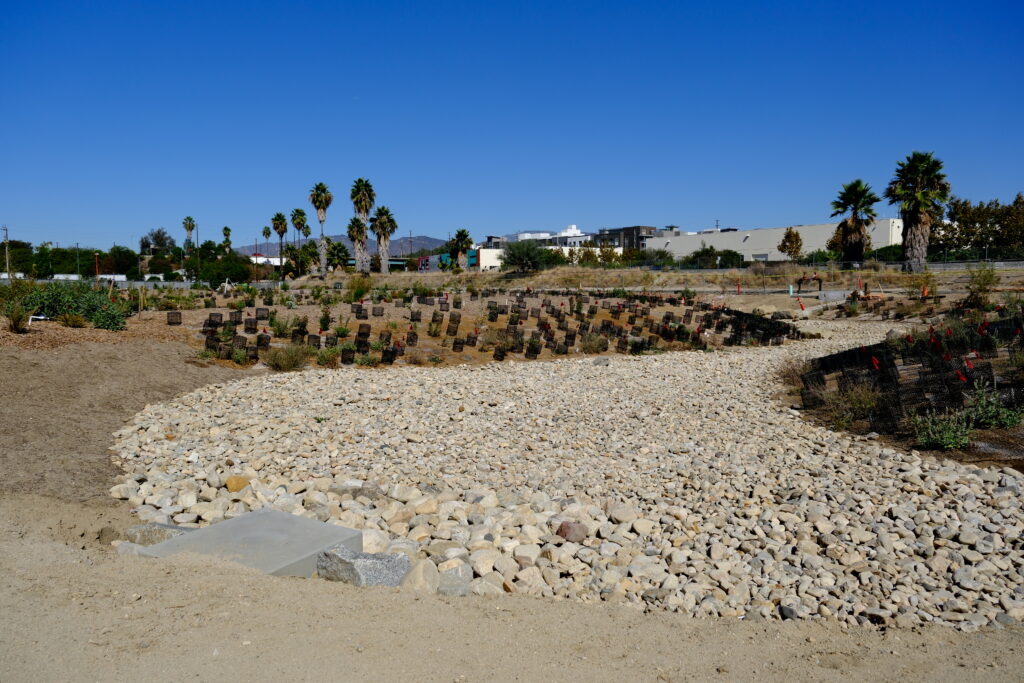
Bowtie Wetland Demonstration, Los Angeles CA
What it looks like: Streets don’t flood every heavy rain. Stormwater is absorbed instead of rushing into homes and basements.
How brownfields help: Some sites are better suited to green infrastructure than buildings: wetlands, rain gardens, bioswales, or flood-storage parks. Cleaning up contamination first also keeps floodwaters from spreading pollutants into nearby neighborhoods and waterways.
Example: Bowtie Wetland Demonstration – Los Angeles, CA Three acres of the former Taylor Yard brownfield site along the Los Angeles River are being transformed into a wetland with support from California Equitable Communities Revitalization Grant funding. Soon, dry weather flow and first-flush stormwater from 3,000 acres of Glendale and Los Angeles will meander through the wetland, supporting three distinct ecosystem zones and cleaning the water before it is discharged into the Los Angeles River. Scientists will monitor how the water is cleaned, improvements to heat island effect, and local species at the site, providing useful information to replicate what works in other communities.
4. Cooler neighborhoods during heat waves
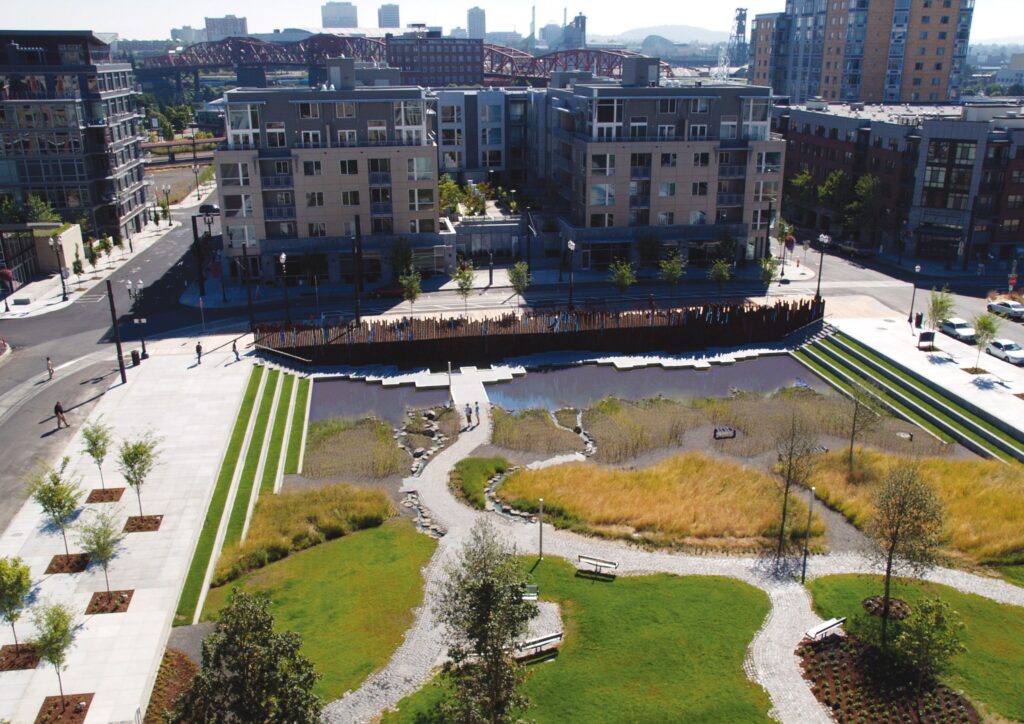
Tanner Springs Park, Portland OR
What it looks like: Shade, tree canopy, and cooling centers keep people safe when temperatures soar, especially elders, kids, and outdoor workers.
How brownfields help: Vacant lots covered in asphalt or bare dirt trap heat. Turning them into parks, urban forests, or community gardens lowers local temperatures. A redeveloped building can also host a designated cooling center or resilience hub.
Example: Tanner Springs Park– Portland, OR This area of Portland was once home to vast marshlands and rich biodiversity. As the city grew, the wetlands were drained to make room for a railyard, industrial facilities and warehouses. Times changed once again and the once bustling industrial area declined, making space for redevelopment and recreation of some of the lost wetland environment. The once-buried Tanner Springs was daylit and restored to wetland habitat. The one-acre park now captures and cleans urban runoff before it enters Willamette River, and provides space for native species and humans alike to enjoy a piece of nature in the middle of the city.
5. Access to healthy food
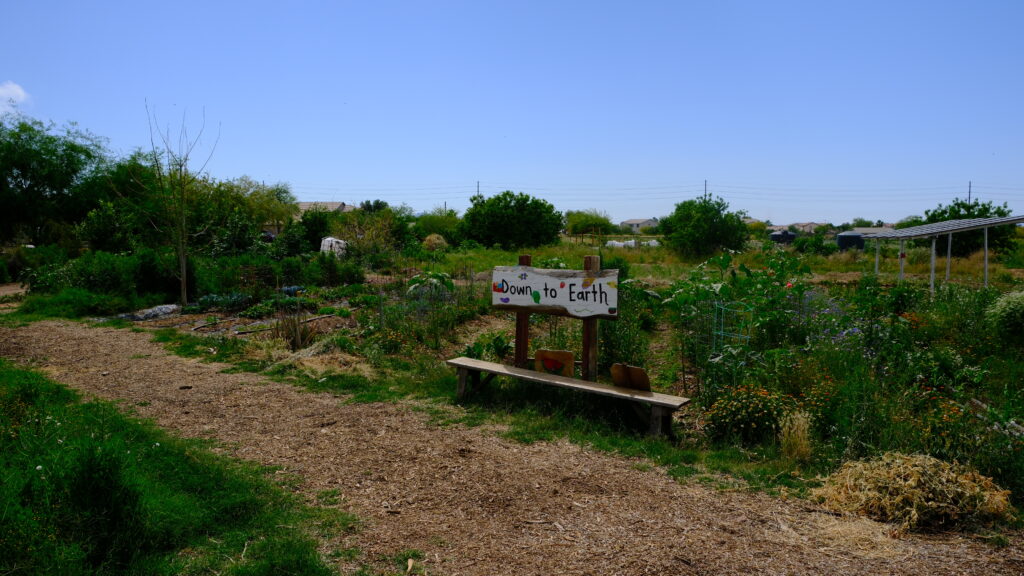
Spaces for Opportunity, Phoenix AZ
What it looks like: Residents can buy fresh, affordable food close to home, and the local food supply doesn’t collapse when supply chains are disrupted.
How brownfields help: Former sites can become grocery stores, farmers markets, food hubs, or urban farms. With proper cleanup and safeguards like raised beds and clean soil caps, even previously contaminated land can safely grow food.
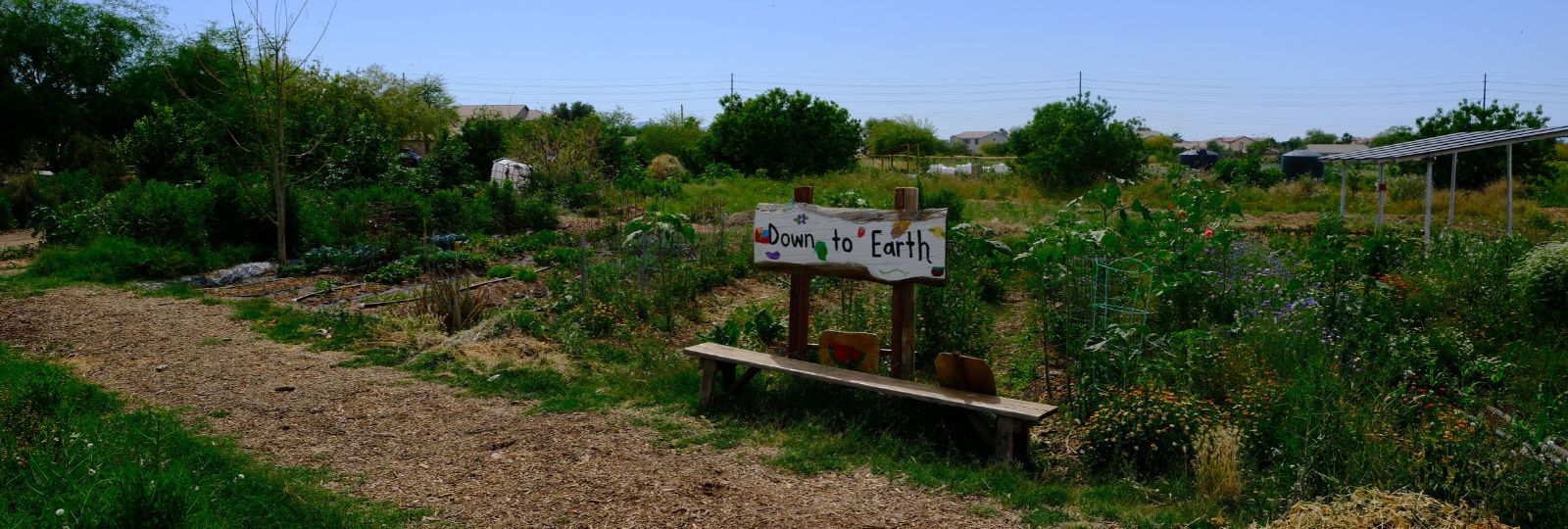
Example: Spaces for Opportunity – Phoenix, AZ: The community of South Phoenix is a USDA-designated food desert, which means residents have to drive more than a mile away to access a grocery store. The City of Phoenix found a creative way to solve this problem with the help of some surplus land owned by a local school district. An environmental site assessment funded by EPA found some areas with high levels of naturally-occurring arsenic. Outbuildings, parking and other non-food uses were set on these locations to ensure food is only grown in healthy soil. This once vacant lot has been transformed into 19 acres of urban farms and a local farmers market, providing healthy, locally-grown food to neighbors, and income for local farmers.
6. Clean air, water, and soil
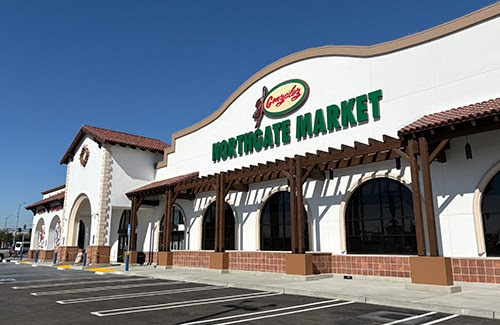
Northgate Market, Lynwood CA
What it looks like: People aren’t getting sick from the environment they live in. Kids can play outside without worry.
How brownfields help: This is the most direct benefit. Environmental remediation removes or safely manages contaminants that may be seeping into soil, groundwater, or dust. Even before redevelopment, simply identifying and securing a site reduces health risks for neighbors.
Example: Northgate Market – Lynwood, CA: a former gas station stymied development of a busy intersection in Lynwood for more than two-decades. Extensive petroleum contamination made the site too expensive for private developers or the City to redevelop. What’s worse, the hydrocarbons had reached the aquifer the city relied on for drinking water. With $4.8 million in cleanup support from the California Equitable Communities Revitalization Grant, the ground and water were cleaned and the site has been transformed into a grocery store and retail center, eliminating a food desert and creating more than 200 local jobs.
7. Reliable energy when the grid goes down
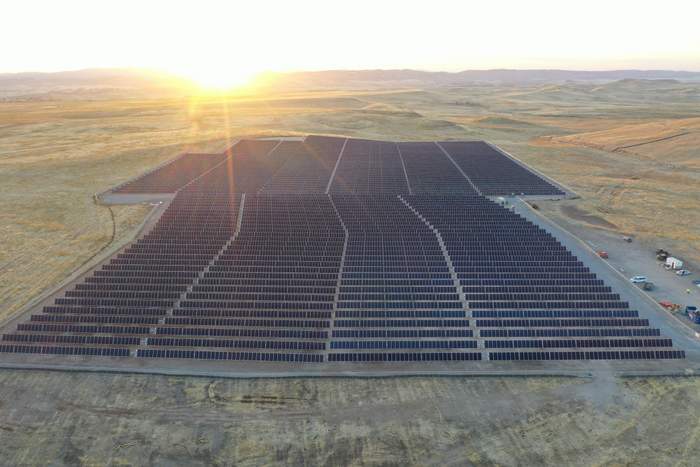
Foothill Landfill, Linden CA (Photo credit: Ameresco)
What it looks like: Renewable energy, critical services, clinics, shelters, community centers, keep the lights on during outages and Public Safety Power Shutoffs.
How brownfields help: Large, flat sites that are hard to build on, like old landfills or capped industrial parcels, are often good fits for solar arrays, battery storage, or community microgrids. These projects can power nearby facilities and lower energy costs for residents.
Example: Foothill Landfill – Linden, CA: After the Foothill Landfill in San Joaquin County reached capacity, it entered a new phase of service for the community. Today, the landfill operates a 5.3 MW photovoltaic solar system and a 4.3 MW landfill gas-to-energy (LFGTE) plant. Combined, the two facilities provide enough electricity to power more than 3,400 homes and offset the same amount of CO2 as removing 6,500 vehicles from the road.
8. Places to gather and connect
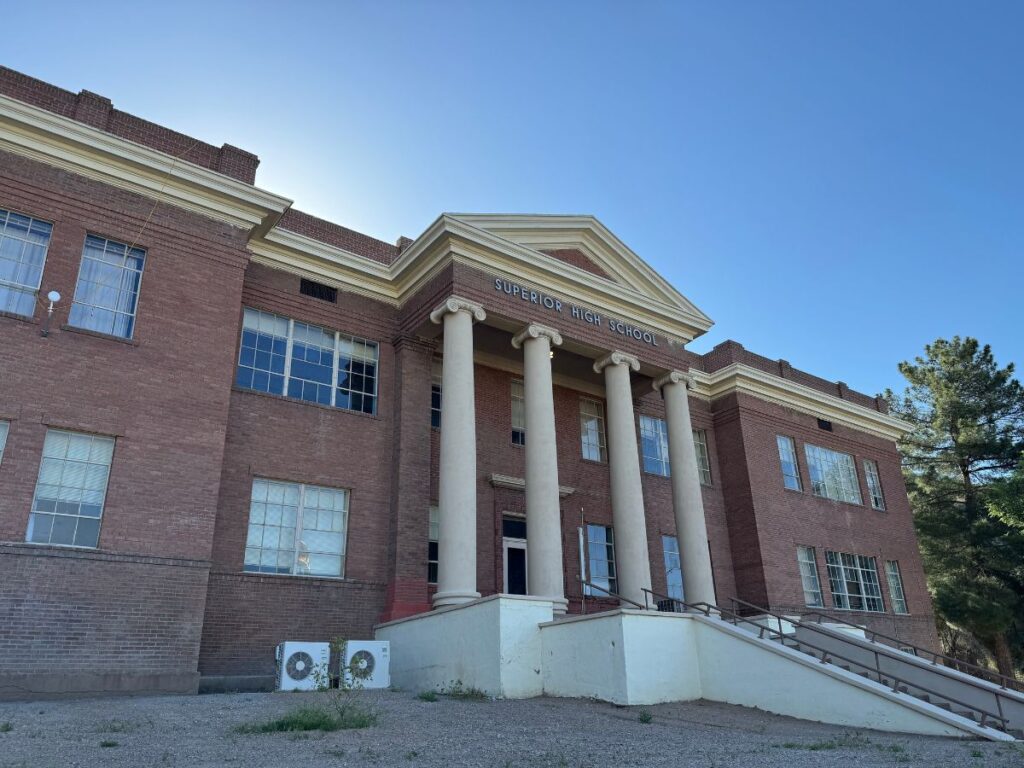
Multi Generation Center, Superior AZ
What it looks like: Neighbors know each other. When a crisis hits, people check on one another, share resources, and organize quickly.
How brownfields help: Redeveloped sites can become libraries, plazas, community centers, recreation fields, or cultural spaces. These “social infrastructure” projects build the relationships that research and lived experience show are among the strongest predictors of how well a community recovers.
Example: Multi Generation Center – Superior, AZ: 100 years ago Superior opened its first High School, the large, brick building with stately columns looked out over the small mining town and declared “education is important here”. When a new high school was built in the 1990s, the old one closed. Today, the school is being reimagined into a community hub. Several city departments are being relocated to the school to save on energy and maintenance costs. The school will also serve as a community hub; housing a community library, gym, senior center, business incubator, technology center and job training center to support Superior residents at every stage of their lives. Watch the Video
9. Community voice in decisions
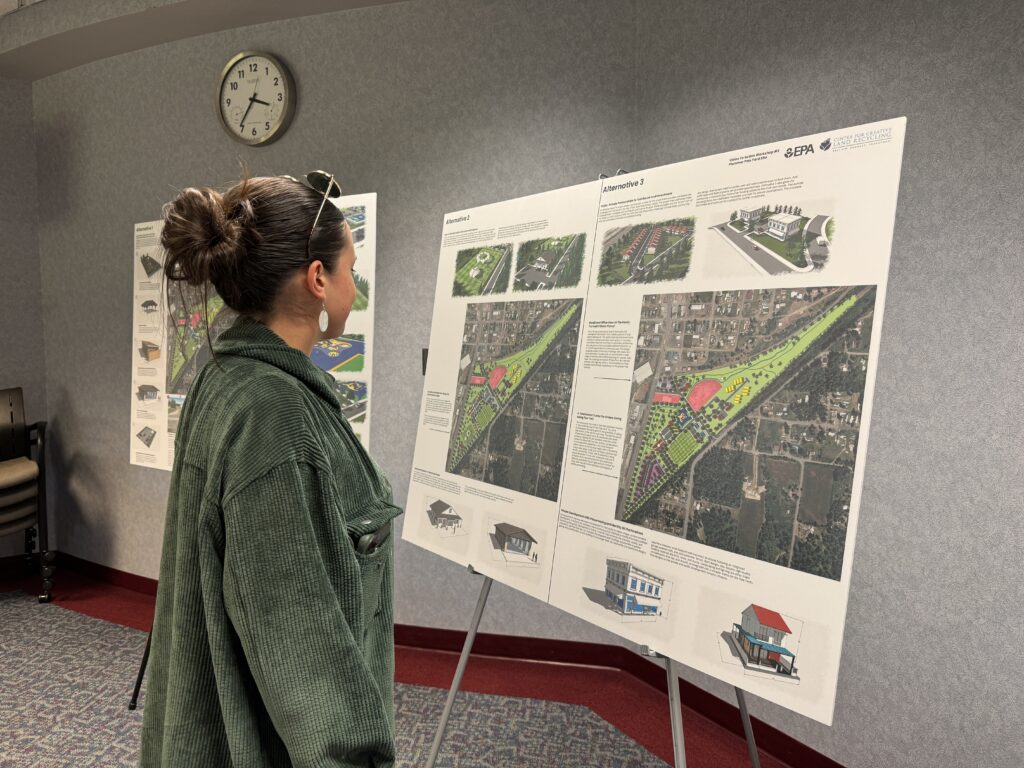
Poleyard, Plummer ID
What it looks like: Residents, especially those historically left out, have real influence over what happens in their neighborhood. Plans reflect local priorities, not just outside interests.
How brownfields help: A brownfield project is a natural starting point for community engagement. Residents can help decide what a site becomes, which builds civic capacity, trust, and leadership that carries over to the next challenge. It also helps guard against redevelopment that displaces the people it was meant to serve.
Example: Poleyard– Plummer, ID: The small city of Plummer has a big, empty triangle in the middle of it. The former poleyard divides the community and makes it difficult for students who live south of the property to walk to school. Additionally, the Coeur d’Alene Tribe wants to restore and clean Plummer Creek at the poleyard site. Through the CCLR Vision to Action process, the Tribe and City came together with local residents to identify needs and priorities for the site. Recently, the Tribe solicited proposals for engineering support to restore the creek, develop a walking trail, capture and clean stormwater, and develop a parking lot and community solar to increase benefits to the community. Watch the Video
10. Strong local government and fiscal health
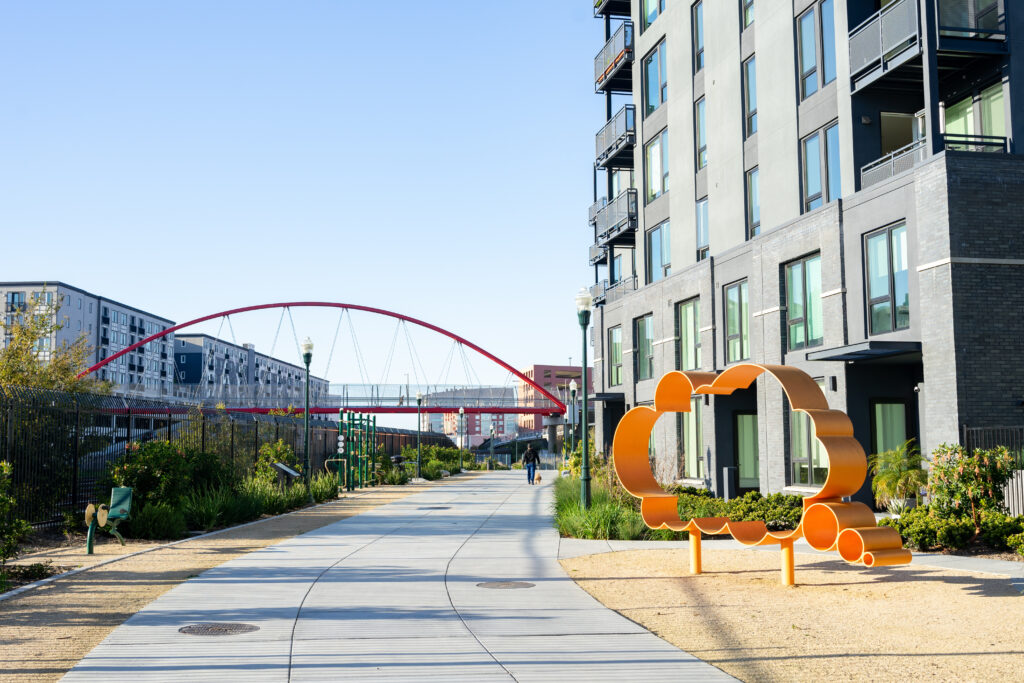
Greenway and South Bayfront Pedestrian Bridge, Emeryville CA
What it looks like: Cities and counties have the tax base and capacity to maintain services, respond to emergencies, and invest in the future.
How brownfields help: Vacant, contaminated properties often generate little tax revenue and can drag down surrounding property values. Returning them to productive use broadens the tax base. Along the way, local staff gain experience securing grants, managing cleanup, and building partnerships, skills that strengthen a community’s capacity for whatever comes next.
Example: Emeryville, CA: The City of Emeryville is only 1.27 square miles in the heart of the San Francisco East Bay. A former industrial giant, more than a third of the city qualified as brownfields. Unable to build out, the City looked at its contaminated, abandoned and under utilized sites as an opportunity to reinvest the city from a center of industry, to a hub of innovation. Emeryville secured one of the first brownfield pilot grants in 1996. In the thirty years since then, the City has successfully assessed, cleaned up and redeveloped more than 300 acres into everything from housing, open space, transit centers, and employment centers. The redevelopment benefitted from funding from EPA, California Department of Toxic Substances Control, $5.4 million in tax increment financing (TIF). The redeveloped sites have created an estimated 8,400 jobs and hundreds of millions in value to the City.
The common thread
Resilience isn’t a single project or limited to a buzzword. It’s the sum of many everyday conditions: housing, jobs, health, energy, relationships, and local capacity that determine whether a community bends or breaks under pressure.
Brownfields touch nearly all of them. A single site, thoughtfully redeveloped with residents at the table, can deliver several of these benefits at once: a solar-powered community center with affordable housing above it, or a flood-storage park with a food hub at its edge.
Where to start
If there’s a vacant or underused property in your community that you suspect may be contaminated, that site may be an opportunity in disguise. CCLR works with communities, local governments, and tribes to assess sites, find funding, and plan reuse that reflects local priorities.