Cloudfields, Anyone? Balancing community needs and data center demands for reclaimed land
The Center for Creative Land Recycling (CCLR) staff have had the privilege of reviewing session proposals for the National Brownfields Conference for many years. For BF2027, there was a waterfall of ideas regarding Artificial Intelligence (AI) and data centers compared to only a trickle in BF2025. How to utilize AI to benefit brownfield reuse, and the physical development of data centers, are two distinct topics—but they are joined at the hip.
More AI use leads to more data center demand, as do increased use of our connected devices, such as smartphones, TVs, computers, appliances, medical devices, autonomous vehicles – the list goes on – exponentially increasing demand for data processing and storage. Siting data centers has quickly become one of the most hotly contested real estate and infrastructure issues in the country [1,2]. Where are these data centers going to go? Do brownfields and other contaminated sites—Superfund, petroleum sites, dormant BRAC and FUDS sites and closed landfills—have a place for them? The federal government thinks so, strongly recommending former industrial properties as prime reuse candidates [3,4].
While anyone can express suggestions for land reuse, at the end of the day local governments and their communities, and tech companies will decide where data centers are built [2]. If your community is grappling with decisions around data center development and brownfield reuse, CCLR can provide guidance in the decision making process.
Welcome to the new world of cloudfields – data center reuse on brownfields.
Estimating and meeting data demands
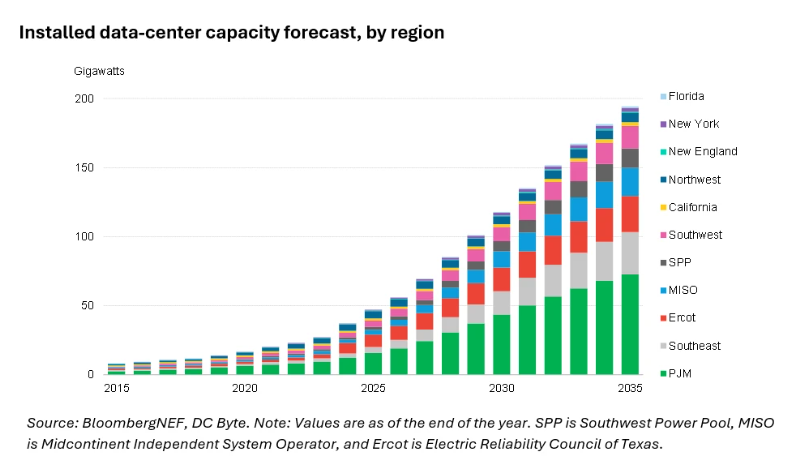
The sheer volume of computing demand coming our way is difficult to wrap your head around:
- Capacity Growth: U.S. data center electricity capacity is on track to more than triple, skyrocketing from roughly 31 Gigawatts (GW) to nearly 95+ GW by 2030 [5,6]. That’s more than the electricity use of the state of Texas [6,7].
- Building Footprint: To house millions of new, high-density server racks will require an estimated 1.2 billion to 1.5 billion square feet of industrial building space in the United States alone [8,9].
- Land Footprint: Server buildings typically occupy only 20% to 30% of a parcel. Adding to that security setbacks, expansive cooling yards, stormwater basins, and dedicated electrical substations, meeting 2030 demand will require 40,000 to 50,000 acres —a footprint roughly the size of Washington, D.C.[8, 9]. Minimum and average parcel sizes are about 10 acres for smaller facilities, surging past 200 acres for massive “gigascale” or “hyperscale” campuses [8,10].
But what about the final frontier?
While tech gurus have floated the idea of launching data centers into space to bypass Earth’s land and grid battles, orbital computing is still “Musk in the Wind” as it is economically impossible, at least until the mid-2030’s. Standard servers cannot exist in a vacuum without massive, heavy space-grade cooling radiators and millions of square feet of solar panels. Even with optimistic rocket cost reductions, launching a single large-scale facility would demand an aerospace budget exceeding $1 trillion to $2 trillion [11]. So let’s get down to Earth.
Can – and should – brownfields host data centers?
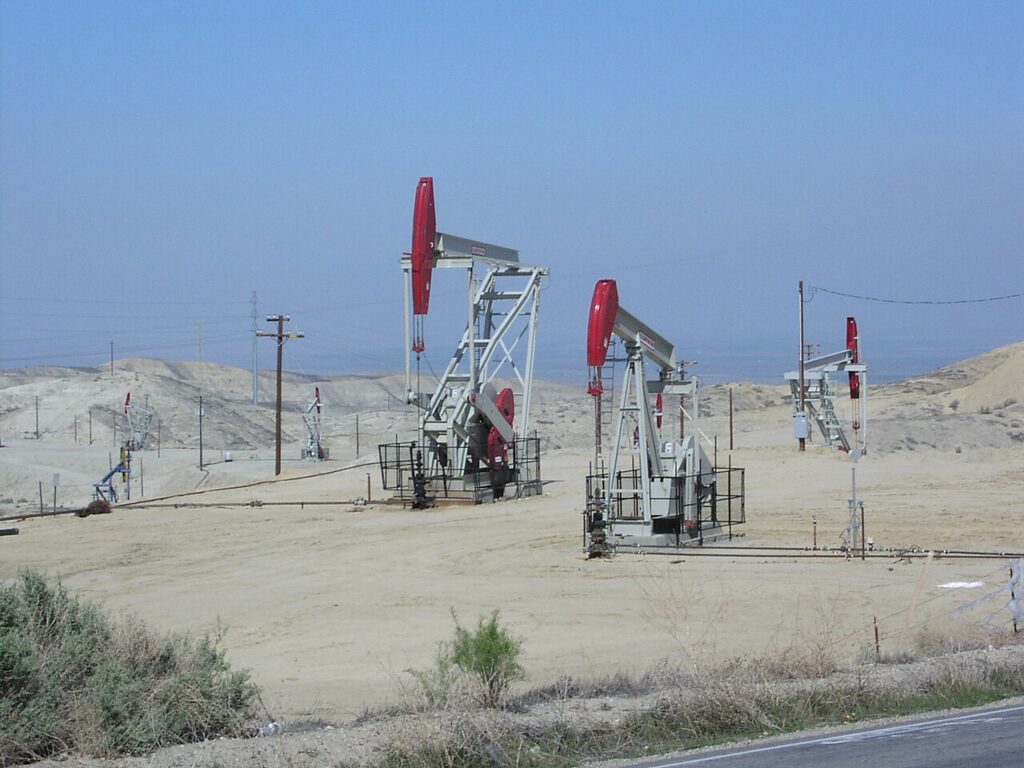
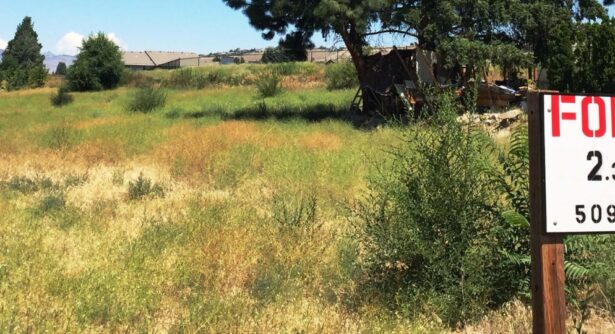
The Elk Hills Oil Field near Taft, CA is the site of a planned Cloudfield. The Golden Valley Technology Hub would be powered by an existing LGN power plant, built to power oil extraction, and would use a closed-loop cooling system to drastically reuse water use. The site is 8 miles outside of town, reducing noise and view impacts. Still, the project faces opposition.
Regardless of how you view data centers, there are benefits to building them on brownfields [4]. EPA data on existing regulated sites and extrapolations of potential sites range from 81,000 to over 1 million sites [3,12] – brownfields, Superfund, BRAC, FUDS, RCRA sites, and closed landfills across the United States. These sites represent unique opportunities because legacy properties often feature existing high-voltage power lines, water hookups, and industrial zoning. Data centers can absorb more expensive remediation projects, and perhaps, being an industrial reuse, require less restrictive cleanups [4,13].
Does the data center need to be in my backyard?
Neighbors often ask this question about any development in their community– from infill housing to data centers. The reality is that people will continue to stream videos, play online games, share and save multiple copies of photos and videos, mine for crypto, use autonomous vehicles and yes, use AI, etcetera. Blocking essential digital and physical infrastructure locally does not reduce demand, it merely forces development into inefficient locations, or often into environmental justice communities with fewer resources to oppose development. [1,2,20]. When data centers cannot be efficiently sited, utilities are forced to build miles of costly new transmission lines and distant greenfield grid expansions [5,14]. Ultimately, those systemic inefficiencies create a hidden tax that everyone pays through higher fees, monthly electricity bills, elevated rents, and increased municipal service costs [2,14]. Integrating these facilities thoughtfully into our local land-use plans isn’t just good planning—it’s cost protection for the entire community [2].
Accelerating cloudfields with “site-ready” programs
Speed to market is the number one priority for data center developers [8,10]. To avoid multi-year delays, communities can adapt site-ready (or “shovel-ready”) certification programs—like Virginia’s Business Ready Sites or Oregon’s Certified Sites [15,16].
These programs front-load essential due diligence—completing environmental studies, securing zoning approvals, verifying heavy utility capacity, as well as community outreach in advance. By certifying a brownfield as site-ready, development lead times can be slashed significantly, making reclaimed land competitive with undeveloped “greenfield” sites [4,15,16,17].
Site-readiness can include consideration to minimize the environmental and community impacts of data centers. For example: solar, battery and data center co-location – by integrating behind-the-meter solar arrays directly onto data center campuses, these facilities can generate a portion of their own clean, off-grid power during peak hours. Rather than straining the grid and power bills [14,18]. Another example is mandating recirculating cooling systems to reduce direct water use.
Unlocking Local Economic Benefits vs. Competing Community Needs
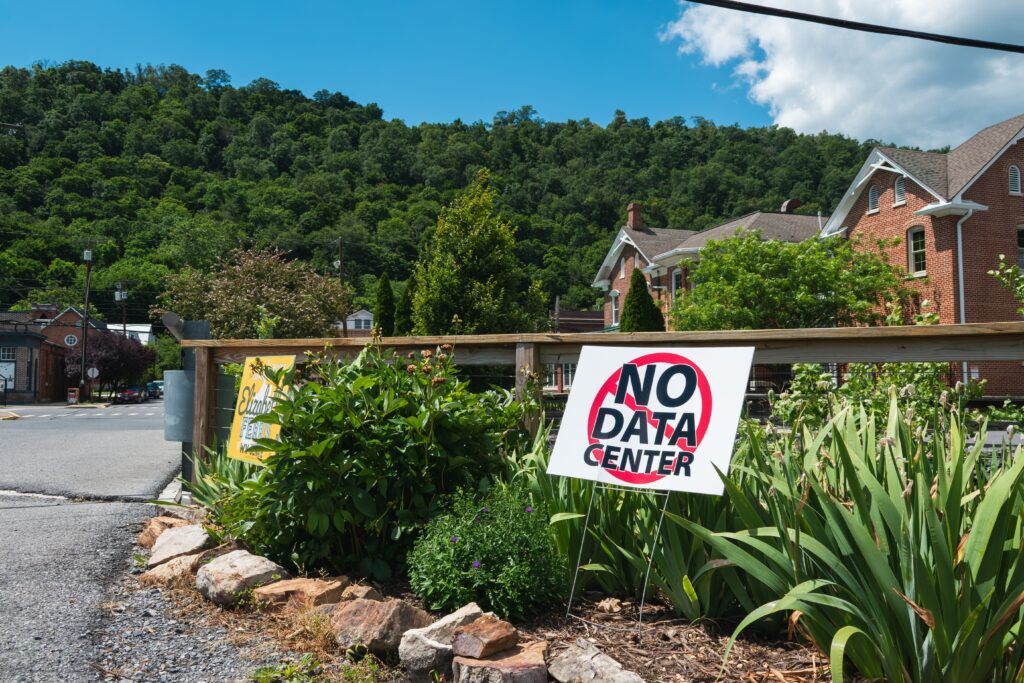
7 in 10 Americans oppose data centers in their community
Data centers are now viewed by local governments as near-term budget fixes, but the economic reality is nuanced:
- Creating Lasting Prosperity: While data centers create a surge in short-term construction jobs, ongoing operational staffing is modest. To turn a data center into a long-term engine for local wealth, communities must negotiate comprehensive Community Benefit Agreements (CBAs). These can secure funding for local school districts, workforce training, protect water and power rates [2].
- Competing Land Uses: Contaminated sites cannot all go to tech. Data centers must make way for other vital community needs, including utility-scale renewable energy, affordable housing, public parks, and local manufacturing [12].
- Public Opposition: Seven in 10 Americans oppose constructing local AI data centers [19], citing concerns below.
Identifying Environmental, Social, and Cultural Impacts
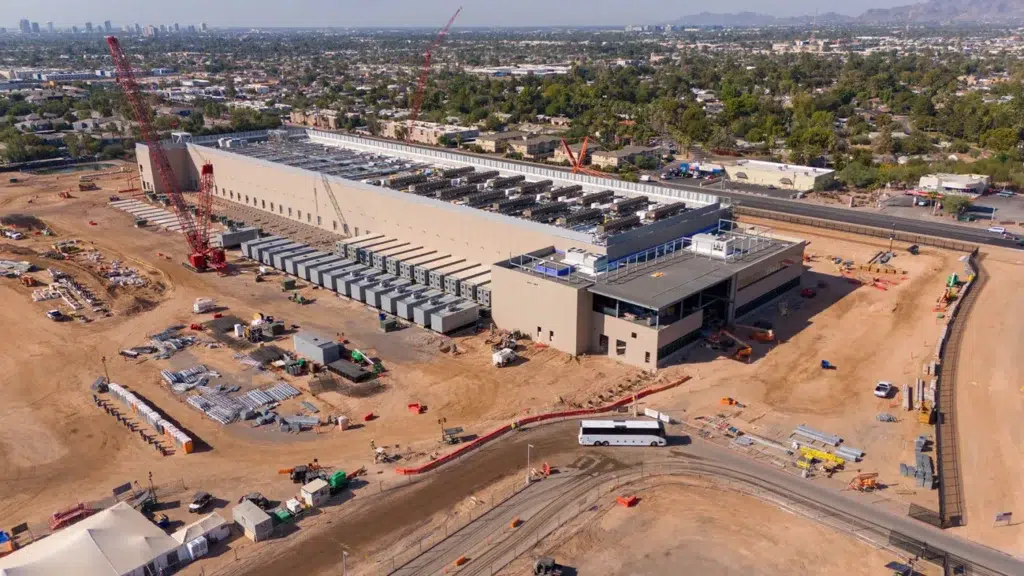
Data center under construction in Phoenix suburb across the street from existing homes
Evaluating a site and community for a data center requires looking far beyond basic engineering. To ensure projects do not harm neighboring residents or repeat past environmental injustices, developers and local leaders must use infrastructure, climate and vulnerability mapping tool [20,21]:
- Socioeconomic & Health Screening: Using tools like Federal and state-level Environmental Health Disparity maps helps identify communities already carrying heavy industrial pollution or high poverty rates, ensuring new projects do not overburden vulnerable neighborhoods, or stress community services and utility rates [2,20].
- Climate & Hazard Resilience: Screening sites against FEMA flood zones, wildfire risk maps, and regional water-stress indicators ensures facilities won’t strain local watersheds or fall victim to natural disasters [21].
- Cultural & Community Buffers: Identifying nearby historic resources, schools, and residential zones allows planners to mandate acoustic walls, landscaped tree buffers, and non-polluting backup power [1,2].
- Fitting in: Mitigating data center features with community-serving and infrastructure supportive buffer uses, like thermal recovery for energy/heating, renewable energy and green infrastructure, vertical agriculture, parks and trails, wetlands, and commercial space, as well as applying architectural and visual mitigation strategies.
But wait – are cloudfields future brownfields?
Data centers are not permanent monolithic structures—they are short-lived containers for rapidly changing technology built on top of land and long-term power assets. Early-generation data centers built between 2000 and 2015—often 50,000 to 100,000 sq. ft. facilities with low power density and air cooling—are becoming obsolete and leave behind abandoned diesel generators and underground fuel tanks, fluorinated refrigerants (PFAS/gases) in old cooling loops; and massive, empty, windowless concrete shells – the very definition of brownfields. Even those built in the next few years may be out-of-date by 2040 [13].
Communities, local governments and developers should plan for a 15-year lifecycle, and consider reuse alternatives. Municipalities should plan for decommissioning upfront so they aren’t left holding vacant concrete bunkers if an operator abandons a facility and have plans for anticipated loss in tax revenue and jobs for when a data center inevitably becomes obsolete. [13].
Next Steps for cloudfields: the impending AI explosion
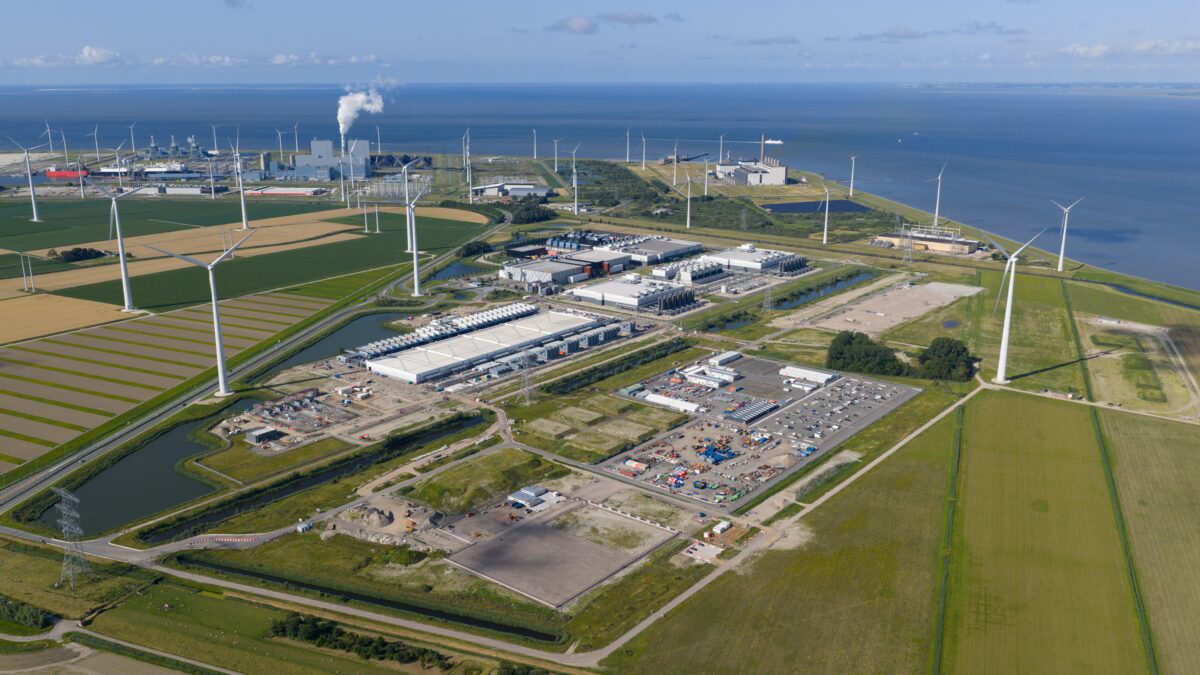
Data Center near Groningen Netherlands shares its space with wind turbines to reduce its energy use/impact
Like it or not, the expansion of data centers directly impacts “what’s in your wallet?”. The ecosystem powering this growth—hyperscalers, tech giants, specialized real estate, and electric utilities—now represents up to 35 percent of the value in typical broad-market retirement portfolios. Furthermore, cloud data center infrastructure now supports the daily operations of up to 85 percent of companies across the S&P 500, spanning banking, healthcare, retail, and logistics [24,25,26,27,28].
If the expanse of current data center influence and projections feel daunting and volatile, they are poised to explode as emerging technologies mature. Today’s infrastructure is built primarily to train and optimize software tools. Once nascent technologies like robotics, autonomous vehicles, smart city grids, and real-time medical systems integrate into our physical infrastructure, processing demands will multiply exponentially [5,6].
The cloudfields we are planning today may look like drops in the bucket compared to what the 2030s physical AI economy will require. Alternatively, engineering leaps in hardware efficiency may allow us to do more with smaller footprints.
Ultimately, until data centers are put in orbit [11], data center siting comes down to local land-use decisions [2]. If you want to explore whether a data center is an appropriate reuse option for your community—and learn how to gauge community support and protect local interests—schedule a meeting with CCLR. We are here to assist with setting up an inventory, site planning, community participation and visioning, and sustainable land reuse.
We’re also looking forward to these discussions at BF2027 in Salt Lake City, and leave you with one question for the audience: “Paper or processed?”
Sources Cited:
- Thompson Hine LLP (May 2026). Vetoed, Not Dead: Maine’s Data Center Moratorium and What It Means for Developers (Tanya C. Nesbitt, Jennifer L. Kendal).
- Brookings Institution (Feb 2026). Turning the Data Center Boom into Long-Term Local Prosperity (Daniel Goetzel, Mark Muro, Shriya Methkupally).
- U.S. Environmental Protection Agency (EPA). Superfund Redevelopment Program & Cleanups in My Community Database.
- U.S. Environmental Protection Agency Guidance (2025–2026). Guidance on the Redevelopment of Superfund Sites as AI Data Centers (Published under Executive Orders 14138 & 14318).
- Electric Power Research Institute (EPRI) (2024–2026). Powering the Digital Economy: Data Center Energy Consumption Trends and Grid Impacts.
- Goldman Sachs Research & BloombergNEF (2025–2030). Global AI & Data Center Infrastructure Footprint and Power Demand Projections.
- Electric Reliability Council of Texas (ERCOT) (2025–2026). System Planning and Capacity Demand Reports.
- Cushman & Wakefield. North American Data Center Market Reports and Site Selection Transaction Trends.
- Commercial Property Executive / CommercialSearch (Aug 2026). Turning Brownfields Into Data Centers (Wyatt Kendall).
- 23ABC News (KERO-TV Kern County) (June 2026). Massive AI Data Center Proposed for Kern County’s Elk Hills (Golden Valley Technology Hub Case Study).
- Aerospace Logistics & Orbital Payload Models. Comparative Engineering & Financial Modeling: Space-Based Radiative Cooling, Payload Launch Mass, and Orbital Solar Infrastructure vs. Terrestrial Facilities.
- Center for American Progress (CAP). Inventory and Spatial Analysis of U.S. Contaminated Land and Industrial Brownfield Redevelopment.
- Bipartisan Policy Center (BPC) (July 2026). Key Considerations for Data Center Development (Kathryn Kline Tyndall, Adam Cowie-Haskell, et al.).
- International Energy Agency (IEA) (2024–2026). Electricity Reports & Data Centers and Energy Transition Outlook.
- Virginia Economic Development Partnership (VEDP). Virginia Business Ready Sites Program (VBRSP).
- Business Oregon. Certified Shovel Ready Program & Regionally Significant Industrial Sites (RSIS).
- Nevada Governor’s Office of Economic Development (GOED) & NNDA. Site Readiness Certification & Opportunity Zone Frameworks.
- CPKC Railway. CPKC Rail-Served Site Ready Program & Industrial Energy Co-Location Frameworks.
- Gallup Poll (May 2026). National Public Opinion Survey on Local AI Data Center Siting, Resource Consumption, and Infrastructure (71% Opposition Metric).
- Front and Centered & Inside Climate News (July 2026). Data Center Development and Environmental Justice Disparities in Washington State (Claire Barber).
- FEMA & Water Stress Indicators. National Flood Hazard Layer & WRI Aqueduct Water Risk Atlas.
- ConstructConnect (May 2026). Data Center Construction Starts Report & National Pipeline Analysis.
- Data Center Watch / 10a Labs (2025–2026). Community Opposition and Project Interruption Tracker.
- Bank of America Global Research & Vanguard Fund Disclosures: Digital Infrastructure, Power Utility, and Data Center Supply Chain Equity Allocations.
- Gartner & McKinsey & Company: Enterprise Cloud Migration, Digital Infrastructure Dependency, and Fortune 500 IT Spending Benchmarks.
- Goldman Sachs Research & Bloomberg Intelligence: Global Hyperscaler Capital Expenditure & AI Data Center Infrastructure Investment Projections (2025–2026).
- S&P Dow Jones Indices & FactSet: S&P 500 Constituent Weightings, Market Capitalization Concentrated Concentration Reports, and Index Sector Breakdown.
- Vanguard Group & Morningstar Direct: Sector Weighting, Index Exposure, and Asset Allocation Models in Standard U.S. Target-Date and 401(k) Retirement Funds.
- Poll shows 7 in 10 Americans oppose constructing AI data centers, FOX NASHVILLE