What Actually Makes a Brownfield Project “Shovel Ready”?
“Shovel ready” gets used loosely in redevelopment circles. Funders like the phrase, elected officials like announcing it, and nearly every project claims it at some point. But what exactly is a “shovel ready” project?
Definitions vary, but generally a project is shovel ready when the cleanup is ready to be implemented, the intended reuse is known, necessary funding is in place, and uncertainty about site conditions has been reduced as far as reasonably possible. Getting there is easier said than done.
You’ll never eliminate every unknown. No amount of sampling completely characterizes a site with decades of industrial history. But a shovel-ready project has been investigated thoroughly enough that the cleanup designed on paper closely matches the cleanup carried out in the field. The project is less likely to require major revisions a few weeks into construction because contamination was discovered that nobody anticipated.
That difference between “we completed an assessment” and “we understand the site” can be significant. Any redevelopment involving former industrial, commercial, or agricultural land carries some version of this risk because of the wide range of potential contaminants and sometimes complex hydrogeology.
Brownfield projects move through four broad phases: Reuse Planning, Pre-Development, Development, and Management.
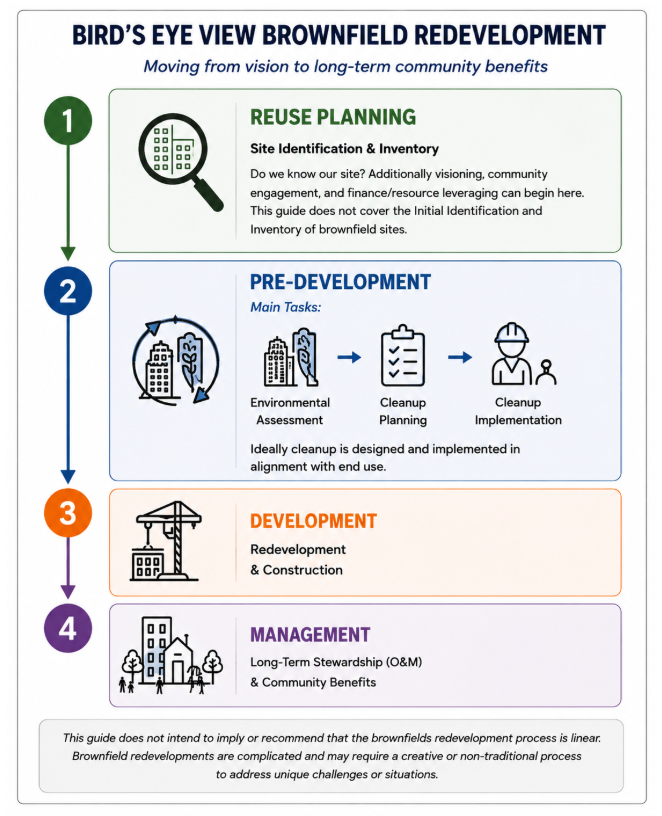
Reuse Planning focuses on identifying sites, understanding community priorities, and exploring funding opportunities. Pre-Development is where environmental assessment, cleanup planning, and cleanup implementation take place. Development covers construction and redevelopment, while Management includes long-term stewardship, operations and maintenance, and ensuring the project continues delivering community benefits.
These phases can overlap, earlier decisions can be revisited and adapted to changing conditions. Even so, this framework provides a useful way to understand where uncertainty is reduced and where unresolved issues become increasingly expensive once a project reaches construction.
Much of the environmental uncertainty is addressed during Pre-Development through environmental due diligence and site characterization, typically beginning with Phase I and Phase II Environmental Site Assessments.
A Phase I Environmental Site Assessment is investigative research. It reviews historical land use, regulatory records, aerial photographs, and current site conditions to identify Recognized Environmental Conditions (RECs) that suggest contamination may be present. Environmental sampling typically does not occur during a Phase I.
A Phase II Environmental Site Assessment is where the investigation moves into the field. Soil, groundwater, soil vapor, or other media are sampled and analyzed to determine what contaminants are present, where they occur, and at what concentrations.
A cleanup plan based only on a Phase I, or on a Phase II that only partially characterizes a site, is built on assumptions.
Many projects need additional sampling to delineate and understand the true extent of contamination. Developing a cleanup plan without adequate characterization creates the risk of discovering additional contamination that exceeds the cleanup budget or disrupts the project schedule.
A common misconception in redevelopment is that reducing upfront investigation saves time. More often, it simply shifts the delay to the most expensive point in the project. Unexpected contamination discovered during construction can trigger additional sampling, revised cleanup plans, regulatory review, contractor delays, and change orders. Issues that could have been addressed during planning become much more disruptive once crews are mobilized.
Whether the owner is a public agency, private developer, nonprofit, or school district, the economics are remarkably consistent. Projects that invest in thorough characterization during Pre-Development are better positioned to move through construction with fewer surprises, fewer delays, and lower overall risk.
Shovel-Ready Brownfield Project Examples
Two recent Equitable Communities Revitalization Grant (ECRG)-funded projects illustrate this principle.
Resources for Community Development’s Nellie Hannon Gateway: ECRG funding supported the cleanup of contaminated soil at this Emeryville affordable housing development, including the removal of more than 2,400 tons of impacted soil and waste. The funding helped offset cleanup costs and allowed other project resources to support construction and operations for the development. During earthwork, the team also encountered a previously unknown underground storage tank beneath the sidewalk, requiring coordination among the environmental consultant and contractor to characterize and safely remove the tank and surrounding soil. The project demonstrates both the value of dedicated brownfield funding and an important reality of redevelopment: even with substantial investigation and planning, unexpected site conditions can emerge during construction, making adequate funding, coordination, and contingency planning essential to keeping a project moving.
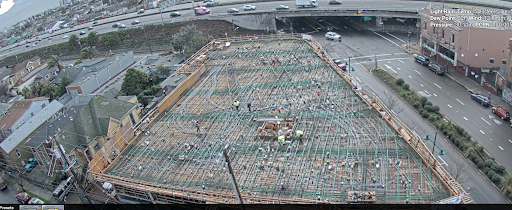
Nellie Hannon Gateway, Emeryville during redevelopment
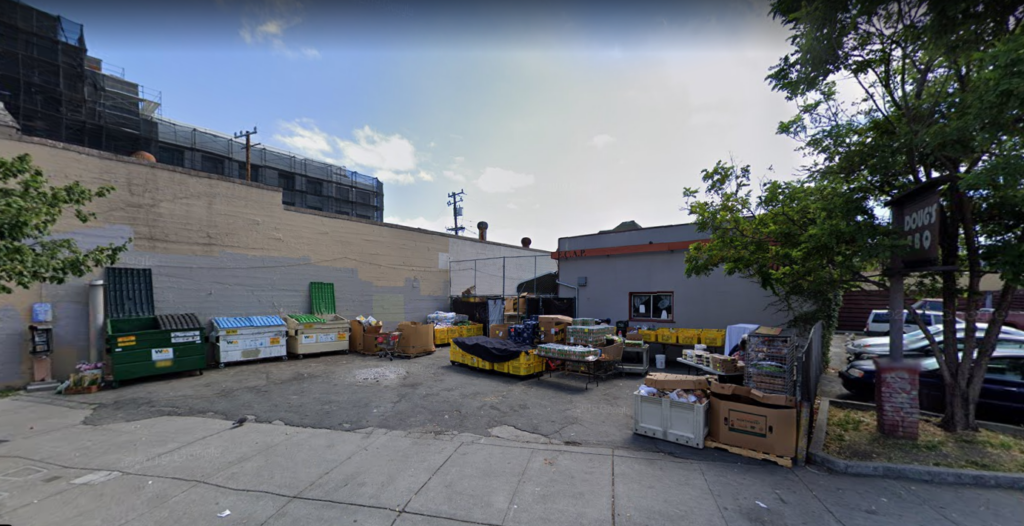
Prior to redevelopment, the site operated as a food pantry
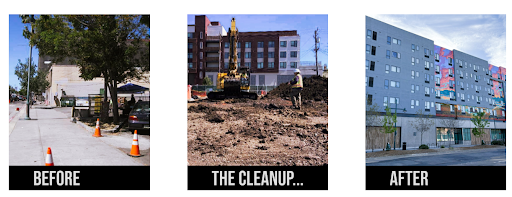
The redevelopment process at Nellie Hannon Gateway
City of Anaheim and Innovative Housing Opportunities’ Lincoln Beach: The former Americana Motel redevelopment in Anaheim progressed through environmental investigation, a human health risk assessment, a Removal Action Workplan, and an Operations and Maintenance Plan before completing its ECRG-funded cleanup. With cleanup complete, the project broke ground in August 2025 and is moving forward as 47 affordable homes for seniors and transitional-aged youth. The project shows how resolving environmental issues before vertical construction can help clear the way for redevelopment.
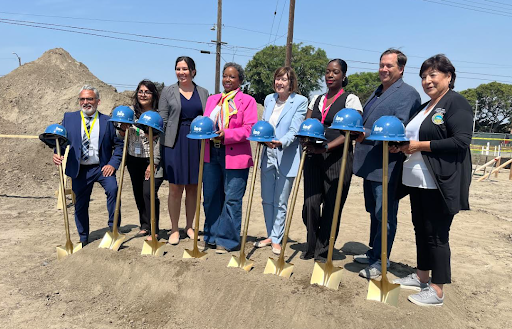
Groundbreaking at Lincoln Beach Apartments in Anaheim
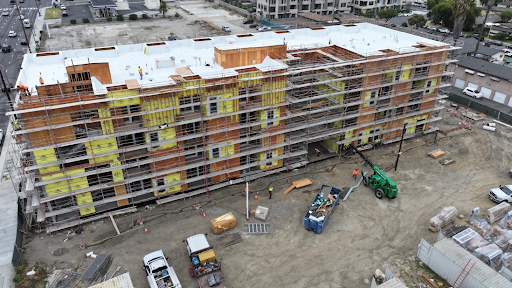
Construction underway at Lincoln Beach Apartments
Neither project reached construction by chance. Together, the projects illustrate how environmental investigation, cleanup funding, and coordination during redevelopment can help projects respond to known and unexpected site conditions.
One of the most useful tools in brownfield redevelopment is the early scoping meeting.
Walking through site history, sampling strategies, data gaps, and the anticipated reuse with the appropriate oversight agency, such as DTSC, before finalizing a workplan can prevent rounds of revisions later. Time spent aligning expectations at the beginning is usually far less costly than remobilizing a field crew or revising a cleanup approach after construction has started.
“Shovel ready” is not something a project declares. It is the result of doing the work necessary to understand the site, plan the cleanup, secure the resources, and reduce the uncertainties that can derail construction.
The projects that move most efficiently are usually not the ones that rush into development. They are the ones that invest enough time during planning and Pre-Development to reduce uncertainty before the first excavator arrives.
Whether a project is funded through ECRG, EPA, other state or federal funding, private investment, or local government, the principle is the same: characterize the site thoroughly, engage the regulator early, and align cleanup with reuse so construction is far more likely to proceed as planned.