A Brownfield Tour Through the Heart of Tucson
What does a remediated oil site, a reinvented motel, a century-old segregated school, and a century old office building have in common? In Tucson, they’re all part of the same story — a city actively reclaiming its past to build a more equitable and vibrant future.
On April 29, 2026, the Center for Creative Land Recycling invites Arizona Brownfield Conference attendees to step off the conference floor and into the neighborhoods where that story is unfolding. Our guided tour will visit four remarkable sites in and around downtown Tucson, each a testament to what’s possible when communities, city leaders, and environmental practitioners work together to transform contaminated and underutilized land.
| Tour at a Glance Date: Tuesday, April 29, 2026 Starting Point: Tucson Realtor Association
Four Stops: 1. Former Flint Oil Site — Barrio Viejo 2. Milagro on Oracle — Oracle Road Corridor 3. Dunbar Pavilion — Dunbar Spring Neighborhood 4. Children’s Museum Tucson’s Education Center — Downtown Tucson |
Stop 1: Former Flint Oil Site — Barrio Viejo
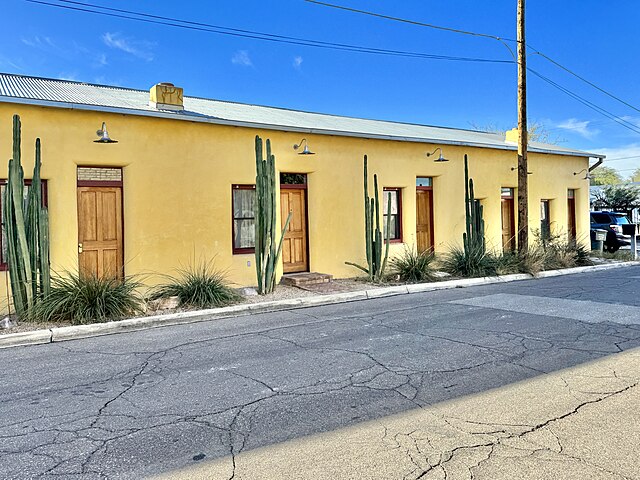
Barrio Viejo is a richly textured enclave of colorful adobe homes and deep Mexican-American heritage just south of downtown Tucson
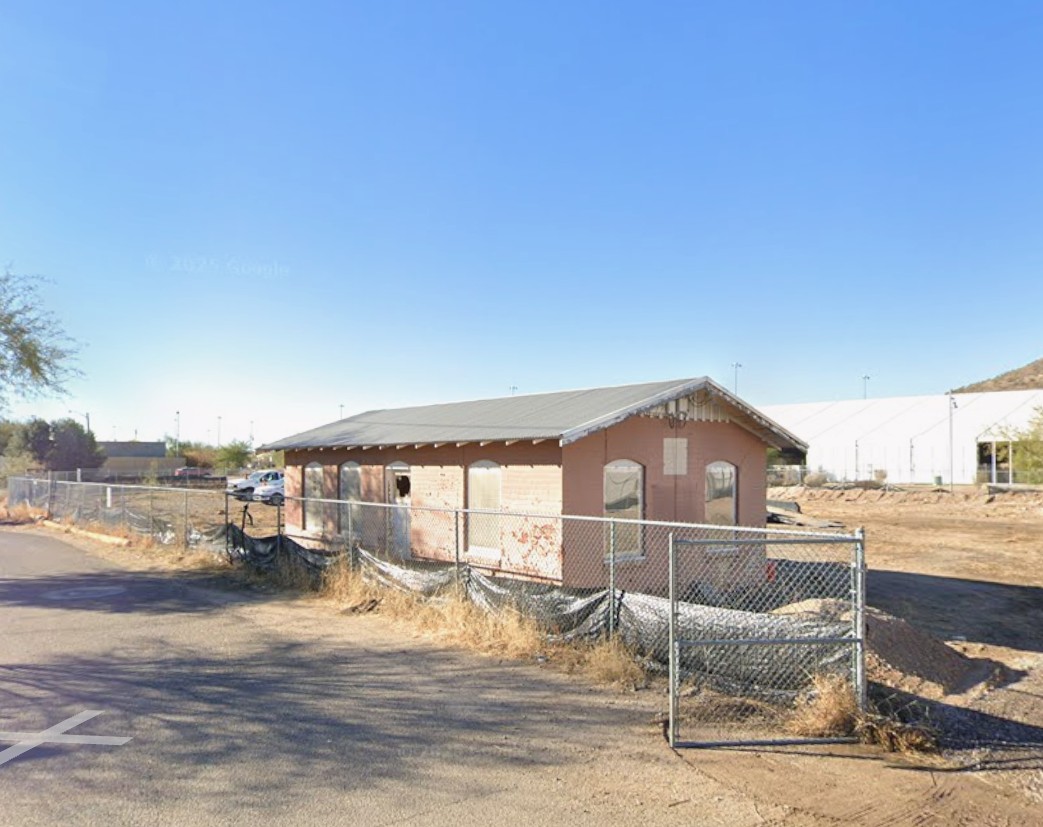
The former Flint Oil site provides opportunity for redevelopment and investment in Barrio Viejo
Our tour begins at the former Flint Oil site, located near one of Tucson’s most beloved historic neighborhoods — Barrio Viejo, a richly textured enclave of colorful adobe homes and deep Mexican-American heritage that sits just south of downtown. The barrio’s layers of history make the work of land remediation here especially meaningful: these are not just contaminated parcels, they are places where community identity and environmental values converge.
The former Flint Oil property was enrolled in Arizona’s Voluntary Remediation Program (VRP) under the Arizona Department of Environmental Quality (ADEQ). The site underwent a rigorous process of site characterization, sampling, and remediation planning spanning several years, with the City of Tucson playing a central role in shepherding the work.
Engineering firm SCS Engineers has provided Phase I and Phase II on-call brownfield services for the City of Tucson as part of this broader initiative, conducting investigations consistent with best practices for voluntary remediation of petroleum-impacted sites.
| 🎤 Speaker: Rolanda Mazeika — City of Tucson Rolanda will guide tour participants through the broader history of the sites we visit, providing context for how Tucson’s brownfield program fits into the city’s larger vision for equitable community revitalization. |
| 🎤 Speaker: Ursula Ginster — City of Tucson Ursula will walk us through the specifics of the Flint Oil Site — the contamination history, the remediation process, and what lies ahead for this important parcel near one of Tucson’s most historically significant neighborhoods. |
Stop 2: Milagro on Oracle — A Miracle on Oracle Road
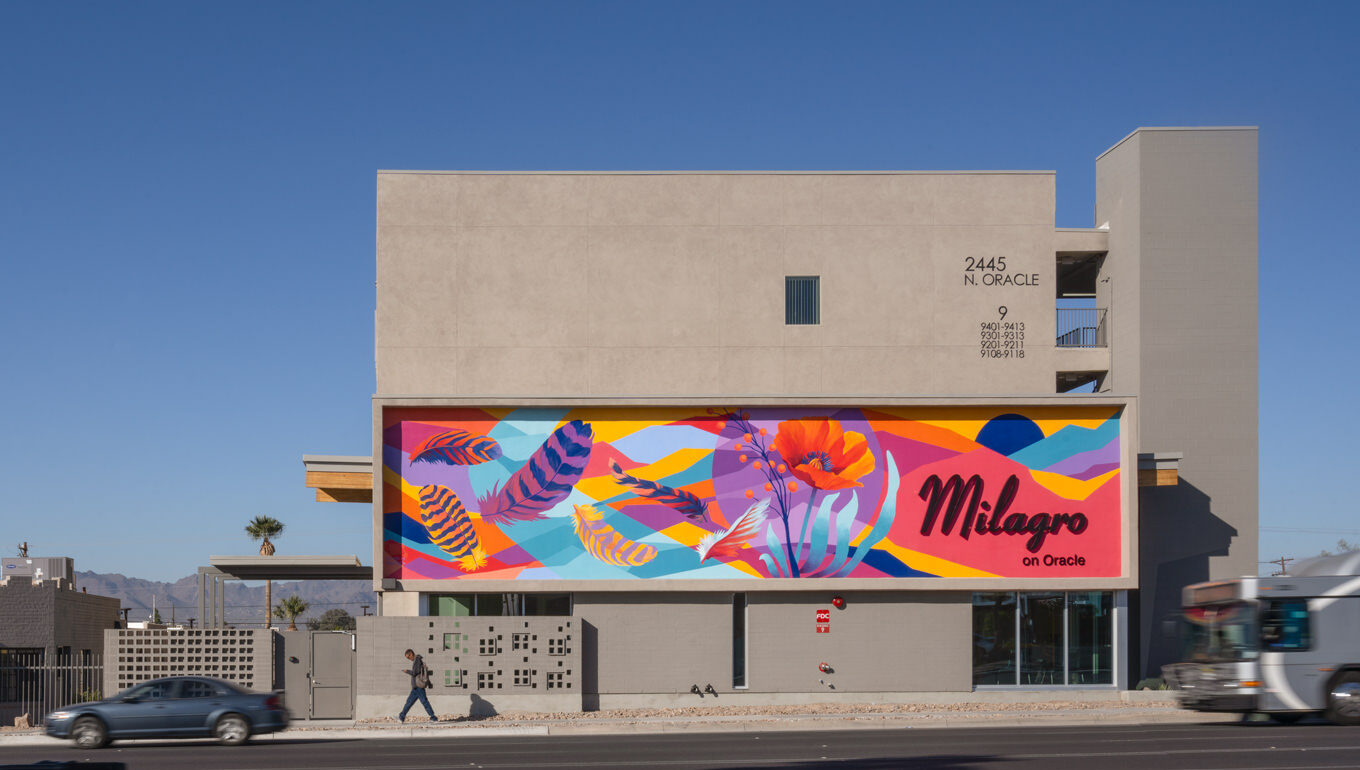
From the Flint Oil site, we travel north to Milagro on Oracle, a striking example of adaptive reuse that has already earned national recognition. Milagro is a redevelopment of the former No-Tel Motel property, providing 63 residences for Tucsonans 55 years and older — including 19 units for unsheltered individuals — and is the City’s first state Low Income Housing Tax Credit project in over ten years.
The project, developed through the City’s nonprofit arm El Pueblo Housing Development in partnership with Gorman & Company, breathed new life into two iconic midcentury motels — the No-Tel Motel and the Don Motel — transforming their historic shells into modern, dignified housing. A new four-story building constructed between the two renovated structures completes the 63-unit complex. Tucson Mayor Regina Romero highlighted how the project merges the need to preserve history with the need to provide affordable housing along Oracle Road’s “Miracle Mile.”
Funded through state tax credits and federal funds, Milagro on Oracle is the first of nine housing developments planned with El Pueblo Housing Development — part of a broader plan for 1,200 affordable housing units across Tucson. When Arizona awarded $18 million through the Low-Income Housing Tax Credit program, city leaders described the funding as exactly what the name implies: a miracle.
| 🎤 Speaker: Johanna Hernandez — City of Tucson — Deputy Director, Housing and Community Development Johanna was instrumental in the Milagro project and will discuss the City’s approach to affordable senior housing and how adaptive reuse of historic structures is becoming a cornerstone of Tucson’s housing strategy. |
Stop 3: The Dunbar Pavilion — A Living Monument to Resilience
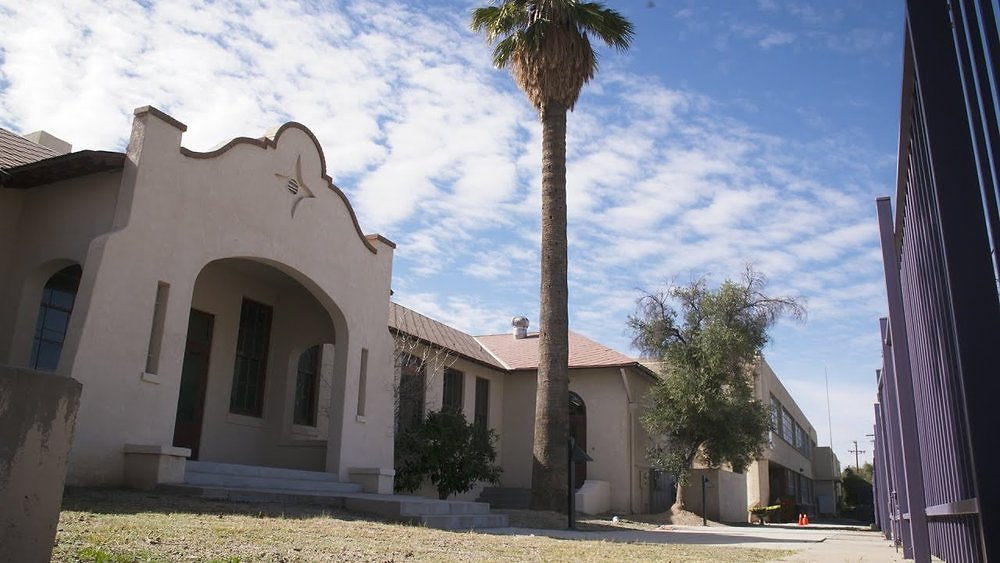
The Historic Dunbar Pavilion celebrates African American art and culture in Tucson
Few places in Tucson carry the historical weight of the Dunbar Pavilion, located at 325 W. 2nd Street in the Dunbar Spring neighborhood near downtown.
The Dunbar building served Tucson’s African-American student population from 1918 to 1951 as a segregated institution — the only school built specifically for Black students in Tucson. It was named after celebrated African-American poet Paul Laurence Dunbar. The school later operated as an integrated school under the leadership of Arizona’s first African-American principal of an integrated school, Morgan Maxwell, from 1951 to 1978. The property is listed on the National Register of Historic Places.
In the 1990s, the Dunbar Coalition — composed of alumni and community members — purchased the abandoned school from the city for $25 with the aim of transforming it into an African American museum and cultural center. Today, the Dunbar Pavilion stands as a vibrant hub for education, arts, and cultural programs, home to community organizations, small businesses, arts initiatives, and the Dunbar Barber Academy.
The City of Tucson has included the Dunbar Pavilion in its Arts & Culture Revitalization Initiative, and federal funding has been secured for ongoing renovations. For brownfield practitioners, the Dunbar represents the human dimension of land reuse — buildings are not simply structures to be assessed and redeveloped. They are the keepers of community memory.
Stop 4: Children’s Museum Tucson — A New Space for Learning
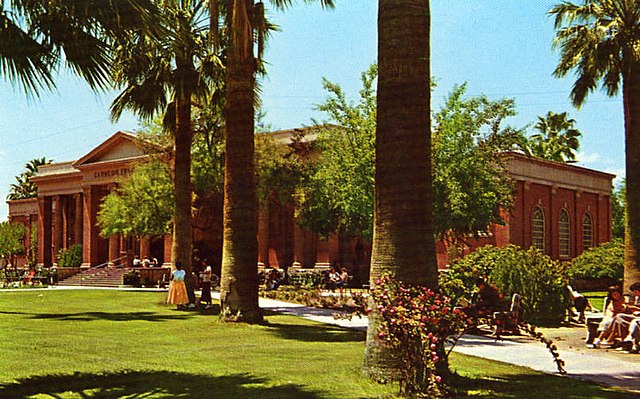
Historic photo of the Carnegie Free Library, Tucson
We conclude our tour at the Children’s Museum Tucson’s Angel Charity for Children Education Center, located at 130 S Scott Ave.in the heart of downtown — and housed in what once served as a medical clinic.
The Children’s Museum Tucson has been a cornerstone of childhood in Tucson for nearly 40 years. Rooted in downtown Tucson within the historic Carnegie Library Building, the Children’s Museum brings joy-filled, play-based learning to Southern Arizona’s children, inspiring generations of families to create, imagine, discover and connect.
As part of a much needed expansion to better serve children and families, an adjacent building at 130 S Scott Ave was purchased and recently renovated to house the Angel Charity for Children Education Center. The Education Center provides multiple program spaces for school group visits, camps, and after-school programs. Administrative offices are also located in the building.
The building, constructed around 1928 was a medical clinic until 1959. It then became office space, hosting a variety of government agencies through the early 80s. It was then registered to various property management agencies before becoming the home of the Tucson Visitors Bureau in the 90s and early 2000s. The Udall Foundation occupied the building from 2008 until acquired by the Children’s Museum in March of 2023. Interior renovations were completed in 2025 and focus is now on the exterior, where asbestos was found on the stucco coating.
The story of this building —from medical offices to an education center — is a model of adaptive reuse that aligns perfectly with CCLR’s mission to promote sustainable, community-led and responsible reuse of underutilized and environmentally-impacted properties. Historic structures, like brownfield sites, are not liabilities. In the right hands, with the right vision, they become community assets for generations to come.
| 🎤 Speaker: Lauren Kaye — Children’s Museum Tucson Lauren will discuss navigating the Brownfields process as a non-profit entity. |
Why This Tour Matters
Brownfield redevelopment is often discussed in technical terms — assessments, cleanup standards, liability protections, tax credits. But at its core, it is about people and places. The sites on this tour represent what happens after the remediation reports are filed and the cleanup contractors pack up. They represent the communities that reclaim their neighborhoods, the seniors who finally have safe and dignified housing, the children who have a beautiful space to learn designed with them in mind, and the descendants of Tucson’s African American pioneers who are preserving a history that might otherwise be forgotten.
The Center for Creative Land Recycling is proud to partner with the City of Tucson and its dedicated professionals to bring this tour to the 2026 Arizona Brownfield Conference. We hope you’ll join us.
Register for the Tour
This tour is offered as part of the 2026 Arizona Brownfield Conference in Tucson, Arizona.
Space is limited. Register Now to secure your spot!